
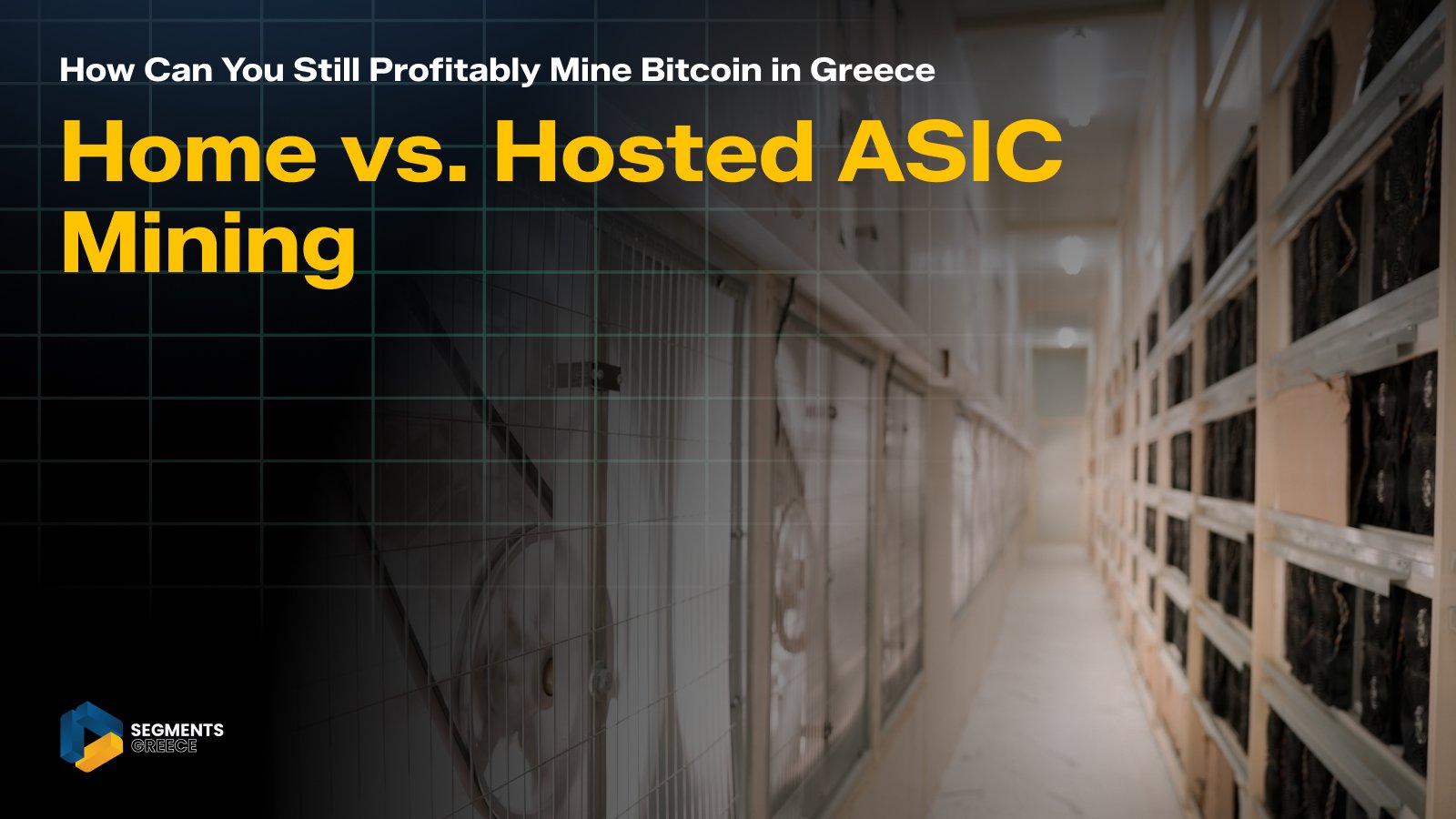
Can you still mine Bitcoin profitably in Greece? The short answer is: not from your home. With retail electricity rates squeezing margins and the Mediterranean summer heat burning out hardware, home mining is economically self-defeating. However, Greek investors are still achieving strong ROI. The secret? Purchasing their ASIC hardware locally and hosting it in industrial hubs like the UAE.
For the contemporary Greek investor, the allure of the digital asset economy is often met with a harsh reality: the prohibitive cost of energy. While Bitcoin remains a primary store of value, the mining operation—the process of securing the cryptocurrency network—has become fundamentally detached from residential viability. In Greece, high electricity prices and grid volatility create an environment where traditional home-based mining is not just inefficient, but economically self-defeating. To participate in the foundational layer of the blockchain, investors must shift their perspective from that of a hobbyist to a strategic capital allocator. This guide explores how hosted mining services allow Greek investors to bypass local constraints by leveraging global energy arbitrage.
The Impact of High Retail Electricity Bills on Mining ROI
The profitability of any professional mining operation is governed by an uncompromising equation: the cost per terahash relative to the price of power. When evaluating this equation in Greece, several structural disadvantages become apparent:
- The Consumer Rate Trap: Retail electricity bills frequently exceed the threshold required for sustainable profit. When you pay consumer-grade rates, the “all-in cost” to produce a single Bitcoin often surpasses current exchange rates.
- Lack of PPAs: Unlike industrial-scale mining companies that secure long-term Power Purchase Agreements (PPAs), residential miners are completely exposed to retail market fluctuations and high European energy taxes.
- Negative ROI Reality: Consequently, calculating ROI in a high-cost environment often reveals a negative or highly vulnerable outcome, making the search for lower-cost energy markets an economic imperative.
At Segments, we’ve seen this margin anxiety firsthand. We understand that without securing competitive industrial pricing, miners simply cannot survive bear markets.
The Physical Barriers: Managing Heat, Noise, and Power Infrastructure in Mediterranean Climates
Home mining in a Mediterranean climate presents severe physical challenges, including heat, noise, and power limitations, which are solved by industrial-grade hosted facilities.
The physical constraints of home mining in Greece extend far beyond the financial burden of electricity bills. Attempting to run industrial equipment in a home environment introduces severe challenges:
- The Thermal Nightmare: The Mediterranean climate introduces intense thermal management challenges. Modern Bitcoin miners (ASICs) generate immense heat, requiring constant, energy-intensive cooling to prevent chips from melting. Attempting this in a residential setting leads to rapid hardware degradation.
- Industrial Noise: ASICs sound like commercial jet engines running continuously. They are entirely unsuitable for residential neighborhoods.
Furthermore, European residential power infrastructure is rarely designed for the constant, high-draw load required by specialized mining computers. This technical bottleneck necessitates a move to institutional-grade facilities where environmental controls, advanced cooling, and industrial power redundancy are standard.
Why the “Home Mining” Era is Effectively Over for European Investors
The era of the “bedroom miner” has effectively concluded. As the difficulty of the cryptocurrency network increases, the hardware required to remain competitive has become increasingly sophisticated and power-hungry. European energy taxes and market instability have rendered small-scale, decentralized crypto mining obsolete.
Investors who persist in home mining are competing against industrial giants—such as those operating in upstate New York or Texas—who benefit from extreme economies of scale. For the serious investor, the transition to institutional-grade hosting is the only path to remaining relevant in the proof of work ecosystem.
What is Mining Hosting and how does it work for Greece investors?
Mining hosting is a strategic model where an investor purchases hardware, which is then housed and managed by a third-party facility. For Greek investors, this means they retain ownership of the asset while outsourcing the operation and maintenance (O&M) costs, electrical procurement, and security to a professional team.
At Segments Greece, we provide a full-stack solution to make this process seamless from zero to hash rate. Here is how we help our investors:
- Local Procurement: We offer direct local stock of ASICs in Greece, eliminating three-month overseas shipping delays so you can start mining immediately.
- Global Energy Arbitrage: We house your hardware in Tier-3+ data centers in the UAE, effectively allowing you to export your capital to one of the most efficient energy markets globally.
- Professional Management: By paying a monthly hosting fee, you secure 95%+ guaranteed uptime, dedicated technicians, and infrastructure that would be impossible to replicate at a domestic level.
Defining the Hosted Model: Owning the Hardware, Offshoring the Operation
The hosted model functions as “Infrastructure-as-a-Service.” The investor buys their own bitcoin miners, but the actual operations take place in an industrial-grade data center. This distinction is vital: unlike “cloud mining” where you rent hash rate, in the hosted model, you own the physical hardware. This gives you the flexibility to move it or sell it as your strategy evolves, while the facility handles the complex logistics of managing high-voltage electrical environments.
Professional hosting facilities offer maintenance that is impossible to replicate at home, including advanced immersion cooling, redundant power supplies, and specialized technicians who perform component-level repairs directly on-site. By tapping into industrial energy contracts, these providers offer electricity rates far below what any individual could negotiate, significantly extending the life and profit potential of the hardware.
Why Mining Pools are Essential for Consistent Payouts
Mining pools aggregate the computing power of thousands of machines to ensure predictable, consistent payouts. This is critical for the hosted model, as it mitigates the “lottery” risk of solo mining. Reliable, consistent cash flow allows the investor to cover hosting fees and manage their hardware portfolio with financial predictability. We’ve seen firsthand that connecting to reliable pools ensures daily revenue streams that make ROI modeling highly accurate.
Comparing Proof-of-Work to Proof-of-Stake: Why Bitcoin Mining Remains a Unique Asset Class
While many projects have pivoted to proof of stake (PoS), Bitcoin remains committed to proof of work (PoW). This distinction is paramount. PoW makes Bitcoin a unique, commodity-backed asset where the cost of production is literally anchored to energy.
Investors often confuse the security models of cryptocurrency tokens like XRP (managed by Ripple Labs) with Bitcoin. Understanding that Bitcoin is a decentralized, energy-backed network is what drives the decision to invest in physical ASIC mining equipment rather than simply holding PoS-based tokens.
How Segments UAE’s datacenter is able to provide Greece investors a super profitable electricity rate
Regions such as the UAE have revolutionized mining by offering access to massive surplus energy at highly competitive industrial rates. By positioning equipment in these hubs, Greek investors can secure long-term contracts that insulate their ROI from the volatility of European grid prices, creating a predictable and highly profitable energy arbitrage strategy.
As the exclusive Greek client-relations company representing Segments Cloud Computing LLC (Dubai), Segments Greece acts as the direct bridge to this Tier-3+ infrastructure. This gives Greek investors localized support, direct local stock for fast equipment availability, and immediate access to UAE-based energy advantages.
Which factors should Greek investors consider when choosing a hosted Bitcoin mining provider?
Selecting a hosting partner requires rigorous due diligence. Investors must evaluate the provider’s track record, the transparency of their energy sourcing, and their ability to provide consistent uptime. Key factors include the provider’s contractual clarity regarding energy pricing, the accessibility of remote management dashboards, and physical security. Here is exactly what you should demand:
Security Protocols: Protecting Your Hardware from Remote Mismanagement
Security is the cornerstone of the hosted model. Investors must audit the security protocols of their chosen facility, ensuring 24/7 surveillance, physical insurance for hardware, and robust cybersecurity to prevent unauthorized access. Treating the host as a secure vault for your digital assets is a non-negotiable step in the vetting process.
Transparency Audits: Verifying Electricity Consumption and Uptime
Professional hosts provide digital dashboards that verify the health of every unit. Periodic audits should be performed to ensure the electricity billed matches the hash rate generated. This transparency is the primary safeguard against “black-box” operations that lack integrity. We prioritize this transparent 24/7 monitoring because building trust requires numbers, not just promises.
Regulatory Arbitrage: Choosing Jurisdictions with Favorable Tax Revenue and Legal Frameworks
Greek investors should seek jurisdictions that offer clear legal frameworks and tax incentives for mining. By choosing regions where local governments view mining as a source of tax revenue (like the UAE), investors can ensure their capital is protected by favorable legislation rather than the rigid, often punitive, tax environments found in much of the European Union.
Infrastructure Quality: Cooling Systems and Power Redundancy
A top-tier host utilizes advanced immersion cooling and atmospheric management systems. High-quality infrastructure is the difference between a machine that lasts for three years and one that fails in one. Redundancy in power delivery is also essential to survive grid fluctuations.
Contract Flexibility: Fixed vs. Variable Electricity Pricing Models
Contracts form the backbone of the relationship. Some providers offer fixed rates for stability, while others offer variable rates pegged to wholesale markets. Choosing the right model depends on the investor’s appetite for risk versus their desire for long-term price certainty.
Accessibility: Dashboard Monitoring and Real-Time Hash Rate Data
The ability to monitor operations remotely is the primary benefit of hosting. A modern provider must offer an intuitive dashboard with granular data—temperature, fan speed, and real-time hash rate—allowing the investor to maintain total oversight of their assets from anywhere in the world.
Build Your Mining Farm From Zero
At Segments Greece, we offer a full-stack solution: local equipment procurement, energy arbitrage in our Tier-3+ UAE data centers, and 95%+ guaranteed uptime. You own the hardware; we provide the global infrastructure.
💬 Get Started Now & Contact Us on WhatsApp or calculate your custom ROI using our Monthly Earning Calculator.
Conclusion
For the Greek investor, Bitcoin mining is no longer a localized technical endeavor. The combination of high electricity bills and regulatory complexity in Europe makes self-managed, residential mining an inefficient strategy.
By embracing the hosted mining model, investors can leverage global energy arbitrage, effectively shifting from the role of a technician to that of a strategic capital allocator. By partnering with professional mining companies that prioritize renewable energy, transparency, and infrastructure efficiency, investors can secure their stake in the most secure cryptocurrency network in existence. As the industry matures, those who treat mining as a strategic allocation of capital rather than a technical hobby will be best positioned to thrive.
The next step is clear: conduct your due diligence, identify a transparent host with proven local infrastructure, and align your energy consumption with the most efficient grids in the world.