
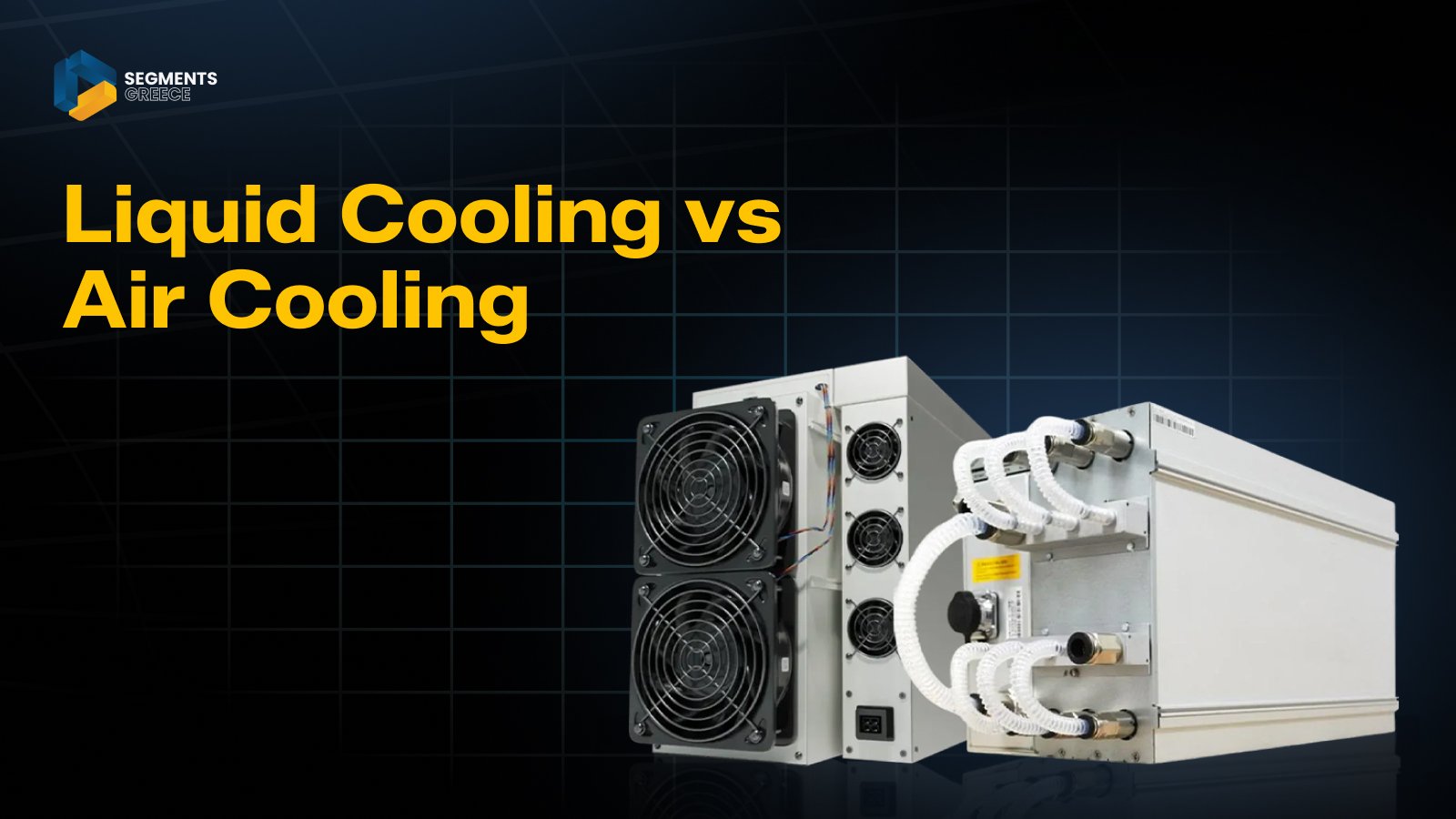
Crypto mining is now big business; every watt and GPU cycle matters. Among the most critical factors in a mining operation is cooling. GPUs and ASIC miners generate enormous amounts of heat at full capacity, and if this heat isn’t managed properly, it can severely reduce performance, shorten hardware lifespan, and even cause catastrophic failures. For miners in Greece, where summers can be scorching, and in the UAE, where ambient temperatures remain high year-round, selecting the right cooling system is not just a matter of convenience; it is a crucial decision that directly impacts profitability.
While there are several cooling options available, the two most common choices for crypto mining rigs are air cooling and liquid cooling. Air cooling has been the traditional choice for decades, favoured for its simplicity and low cost, while liquid cooling has recently gained traction for its efficiency and superior thermal management. This article explores the differences between the two, evaluates their advantages and drawbacks, and provides guidance tailored to miners of all scales, from individual enthusiasts running a handful of GPUs to medium-sized setups and large commercial farms. By the end, you will understand which system is best suited to your operation, taking into account factors such as climate, energy costs, and long-term return on investment (ROI). eat Generation in Mining Rigs
Before deciding on a cooling solution, it is essential to understand how mining rigs generate heat. Every GPU or ASIC in a mining rig operates under maximum load for extended periods, often 24 hours a day, seven days a week. Unlike a standard PC used for gaming or work, crypto miners push their hardware to the limit continuously, which produces immense thermal output. High-end GPUs can reach 80 to 100 degrees Celsius under full load, while ASIC miners in a commercial setup can generate thousands of watts of heat per rack. If this heat is not effectively dissipated, it can cause GPUs to throttle performance, reduce hash rates, and ultimately diminish daily mining revenue.
Moreover, prolonged exposure to high temperatures accelerates hardware wear and tear, decreasing the lifespan of expensive components. It also forces fans to work harder, consuming more electricity and further reducing profitability. In extreme cases, inadequate cooling can lead to system shutdowns or permanent hardware failure. For miners operating in Greece and the UAE, where ambient temperatures are consistently high, efficient cooling becomes even more critical. Without it, miners risk significant income losses and costly hardware replacements.
Air Cooling: How It Works and Its Limitations

Air cooling is the most traditional and widely used method for cooling mining rigs. It relies on fans to circulate air across the surface of GPUs or ASICs, transferring heat away from the components and releasing it into the surrounding environment. Its popularity stems from several advantages. Firstly, air cooling systems are relatively inexpensive, both in terms of initial purchase and ongoing maintenance. They are easy to install, require minimal technical expertise, and pose no risk of fluid leaks, which makes them especially appealing for individual miners or those starting small setups.
Despite these benefits, air cooling comes with significant limitations. Its cooling capacity is limited, particularly for high-density rigs or commercial operations that run dozens or hundreds of GPUs simultaneously. Air cooling is also heavily influenced by ambient temperatures, so in the warm Greek summer or the consistently hot UAE climate, its efficiency drops considerably. Another common issue is dust accumulation, which can reduce airflow and further compromise cooling efficiency if left unchecked. Noise is another factor to consider; fans running at high speeds generate constant, sometimes distracting, noise that can be a nuisance in home or office settings. For small miners with one to ten GPUs, air cooling can still provide sufficient performance if paired with dust filters and proper airflow management. However, for medium- and large-scale operations, relying solely on air cooling may lead to overheating, reduced hash rates, and higher electricity costs.
Liquid Cooling: Efficiency at a Premium
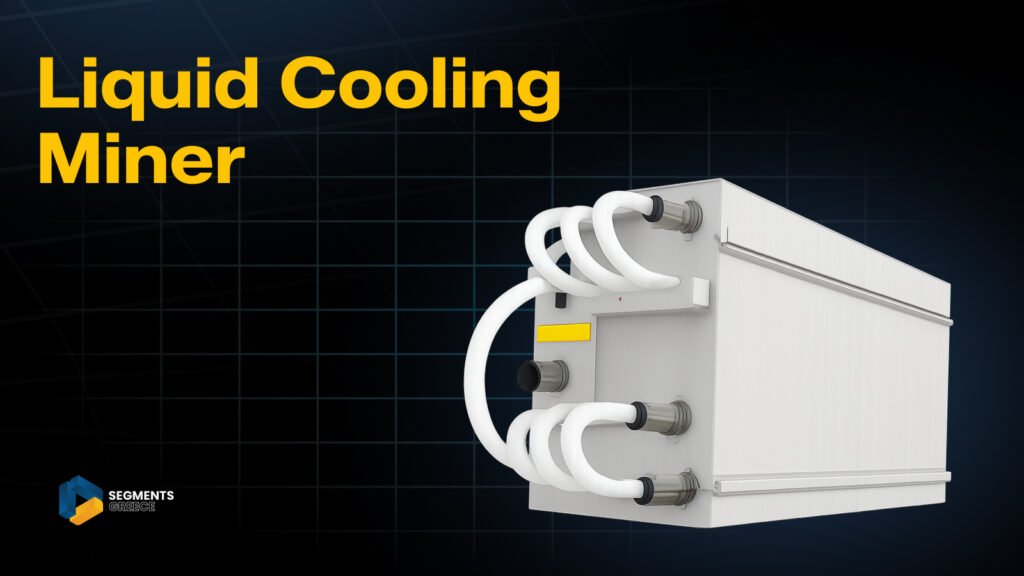
Liquid cooling has emerged as a superior alternative to air cooling, particularly for miners running larger rigs or operating in high-ambient-temperature environments. This system uses a liquid, typically water or a specialised coolant, to absorb heat from GPUs or ASICs, which is then transported through tubes to a radiator for dissipation. There are two main types of liquid cooling: closed-loop systems, which are pre-assembled and require minimal maintenance, and custom loops, which allow full control over coolant flow and heat management but require more technical expertise to install.
The advantages of liquid cooling are significant. It provides much higher thermal efficiency, allowing rigs to maintain lower operating temperatures even under full load. This translates into stable hash rates, reduced throttling, and longer hardware lifespan. Additionally, liquid cooling is generally quieter than multiple high-speed fans used in air cooling systems, creating a more comfortable working environment, especially in commercial farms where noise levels can otherwise become extreme. Liquid cooling also supports overclocking, enabling miners to maximise performance without risking thermal instability.
However, these benefits come at a cost. Liquid cooling systems are more expensive to purchase initially and require careful installation to avoid leaks. Maintenance involves periodically checking hoses, coolant levels, and radiator efficiency, which can be more involved than air-cooling upkeep. Despite these challenges, in extreme climates such as those in Greece and the UAE—where air cooling is often insufficient—liquid cooling’s long-term advantages often outweigh the initial investment for medium- and large-scale mining operations.
Comparing Air and Liquid Cooling for Crypto Miners
When deciding between air and liquid cooling, several factors must be considered:
Cost and Maintenance: Air cooling is cheaper upfront and requires minimal maintenance, whereas liquid cooling demands a higher initial investment and periodic upkeep.
Performance and Stability: In hotter climates, air cooling often struggles as rigs grow larger. Liquid cooling can maintain lower temperatures and consistent hash rates under these harsher conditions, which is critical for medium and large-scale mining operations in Greece and the UAE. Fans running at high RPMs create considerable noise. Liquid cooling systems, by reducing the need for multiple high-speed fans, provide a quieter environment, which is especially beneficial in office or home-based mining setups.
Scalability: Air-cooling supports 1 to 10 GPUs. Liquid cooling is better for dense, commercial setups without airflow constraints. Lower operating temperatures reduce stress on hardware components, extending their lifespan. Liquid cooling provides the best protection in this regard, while air cooling offers moderate protection, particularly in hot climates.
Overall, for individual miners or small setups in moderate climates, air cooling may suffice. For medium- and commercial-scale operations, especially in regions with high ambient temperatures such as Greece and the UAE, liquid cooling is often the more profitable and reliable option.
Real-World Benchmarks and Performance Data
Data from mining communities and farm operators confirm the superiority of liquid cooling in sustained performance. Air-cooled rigs typically run GPUs at 70–85°C under full load, whereas liquid-cooled rigs maintain 50–60°C, even under high ambient temperatures. This temperature difference directly affects hash rates. For example, a 10-GPU rig in Athens operating on air cooling may experience a 5–10% reduction in hash rate during the hottest months, which can directly affect daily income. The same rig with liquid cooling maintains optimal performance, ensuring stable earnings and preventing hardware degradation.
Furthermore, commercial farms in the UAE report that liquid-cooled setups enable denser rack placement and quieter operations, reducing strain on facility management systems and lowering overall energy consumption. These real-world results highlight that while air cooling is cost-effective for small miners, liquid cooling delivers measurable ROI in medium and large-scale operations.
Climate Considerations: Greece and UAE
See how Cold Climate vs Hot Climate Mining affects the profitability.
Both Greece and the UAE pose unique challenges to mining operations due to their climate. Greece experiences hot summers, with ambient temperatures frequently exceeding 35°C, which can significantly reduce the efficiency of air-cooled rigs. The UAE experiences high temperatures year-round, with extreme heat reaching 45°C in some areas, further straining air-cooling systems.
Electricity costs in hot climates rise as fans run harder, especially in Greece and the UAE. Liquid cooling can improve energy efficiency and reduce costs under these conditions. Dust is also more problematic for air-cooled systems, while liquid-cooled systems remain better protected from environmental contaminants common in these regions. In regions with high temperatures, liquid cooling offers a clear advantage, providing reliable performance in challenging climatic conditions while protecting investments and optimising energy use.
Long-Term ROI Considerations
While air cooling may appear cheaper initially, evaluating long-term costs reveals a more nuanced picture. Air cooling systems require minimal investment and are easy to maintain, making them suitable for hobbyists or small setups. However, they offer moderate efficiency and are less effective at protecting hardware from thermal stress, particularly in hot climates. This inefficiency can lead to higher electricity bills, reduced hash rates, and premature hardware wear, ultimately affecting overall profitability.
See How Energy Efficiency Affects Long-Term Mining ROI
Liquid cooling, on the other hand, demands a higher upfront investment and slightly more complex maintenance. Yet, it offers superior thermal management, enabling stable hash rates, extended hardware lifespan, and lower energy consumption. Over time, these benefits often translate into better returns on investment, especially for medium- and commercial-scale operations. For miners in Greece and the UAE, where ambient temperatures are consistently high, the long-term savings from improved efficiency and hardware protection can outweigh the initial cost, making liquid cooling the smarter financial choice.
Common Mistakes and Misconceptions
Despite the advantages of liquid cooling, some miners believe that it is automatically superior in all situations. This is a misconception. For small rigs or moderate climates, high-quality air cooling may perform sufficiently. Another common mistake is neglecting dust filters, which can compromise the efficiency of air-cooled rigs over time. Similarly, attempting to overclock GPUs without proper cooling, whether air or liquid, can lead to thermal throttling and reduce the lifespan of expensive components. Understanding your rig’s scale, environment, and workload is essential to making an informed decision.
Recommendations Based on Mining Scale
For individual miners with one to ten GPUs, air cooling is often sufficient, particularly if supplemented with high-quality fans, dust filters, and proper airflow management. These miners should monitor temperatures closely and consider liquid cooling only if planning to overclock or operate in particularly hot conditions.
For medium-scale miners with ten to fifty GPUs, hybrid systems or full liquid cooling are recommended. These setups benefit from liquid cooling’s superior efficiency while ensuring stable hash rates during periods of high ambient temperatures.
For commercial farms with fifty or more GPUs, liquid cooling is almost indispensable. It reduces noise, allows higher rack density, prolongs hardware lifespan, and ensures consistent performance even under extreme climate conditions. Large-scale operators also benefit from reduced hardware failure risk and the energy savings liquid cooling provides.
Setup and Maintenance Best Practices
For air-cooled rigs, maintaining proper airflow, cleaning dust filters, and ensuring fans operate efficiently is crucial. Liquid-cooled rigs require additional maintenance, including regularly checking hoses, coolant levels, and radiator performance. Regardless of the system, miners should utilise temperature monitoring software to track GPU performance and prevent overheating. Scheduling routine maintenance, monthly for small setups and weekly for commercial farms, ensures optimal efficiency and hardware longevity.
Conclusion
In conclusion, the choice between air and liquid cooling depends on scale, climate, and long-term profitability. While air cooling may suffice for small rigs or hobby miners in moderate climates, liquid cooling becomes increasingly advantageous as rigs grow in size or operate in hot regions like Greece and the UAE. Its superior thermal efficiency, quieter operation, and protection of hardware investment make it the preferred solution for medium and commercial-scale miners.
By selecting the right cooling system and following best practices, miners can maximise hash rates, minimise downtime, and improve ROI, ensuring their mining operation remains sustainable, profitable, and resilient against environmental challenges. Partnering with a trusted supplier in the UAE and Greece guarantees access to high-quality, reliable cooling solutions that can withstand the demands of modern crypto mining.